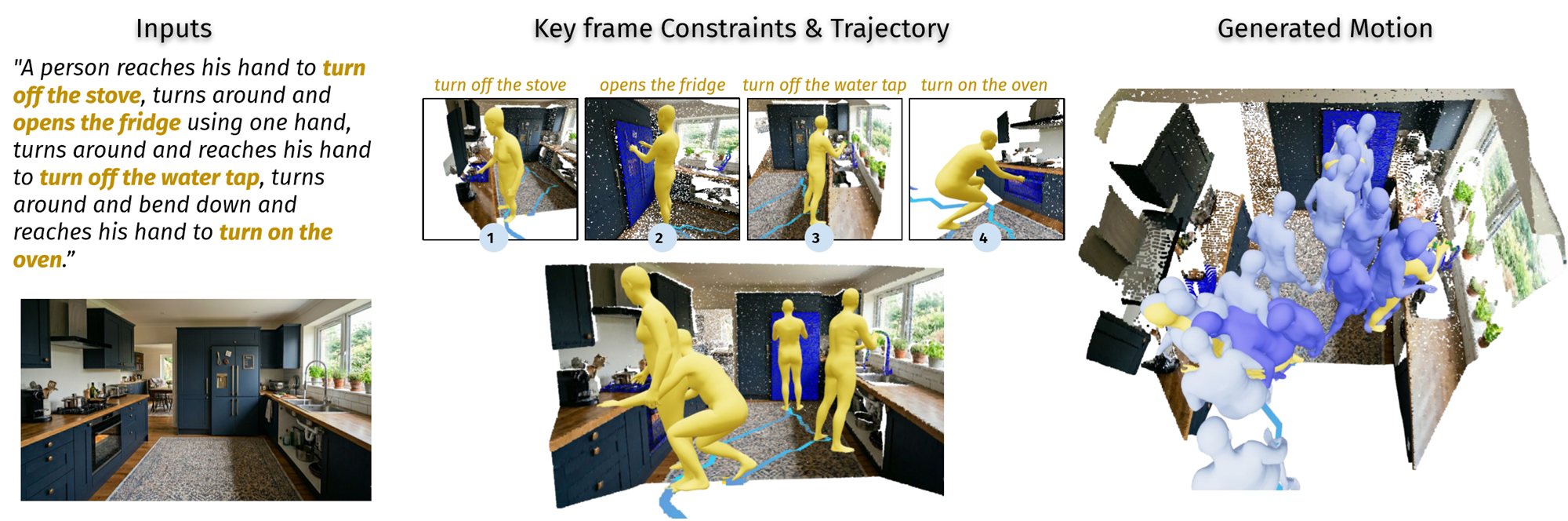
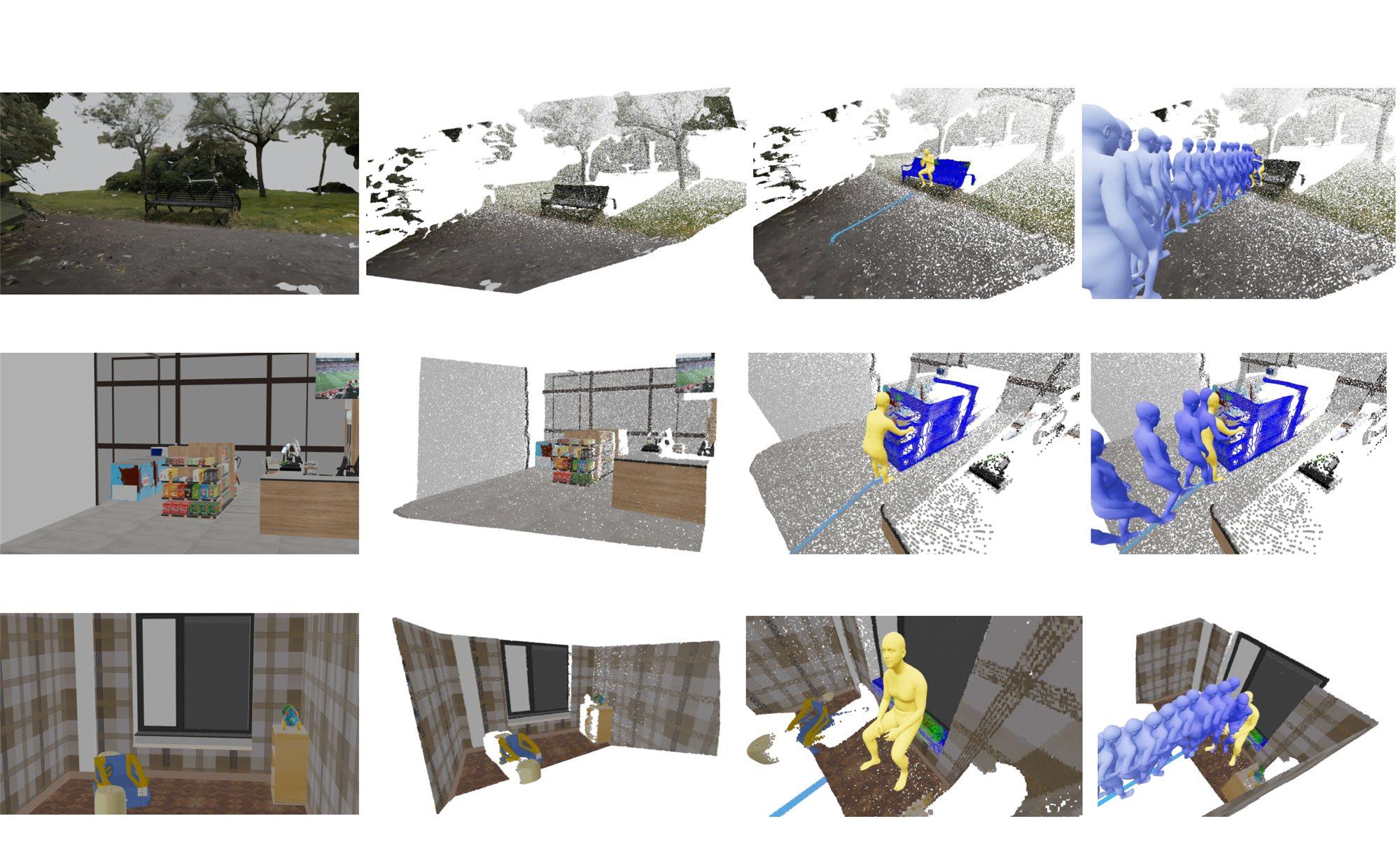
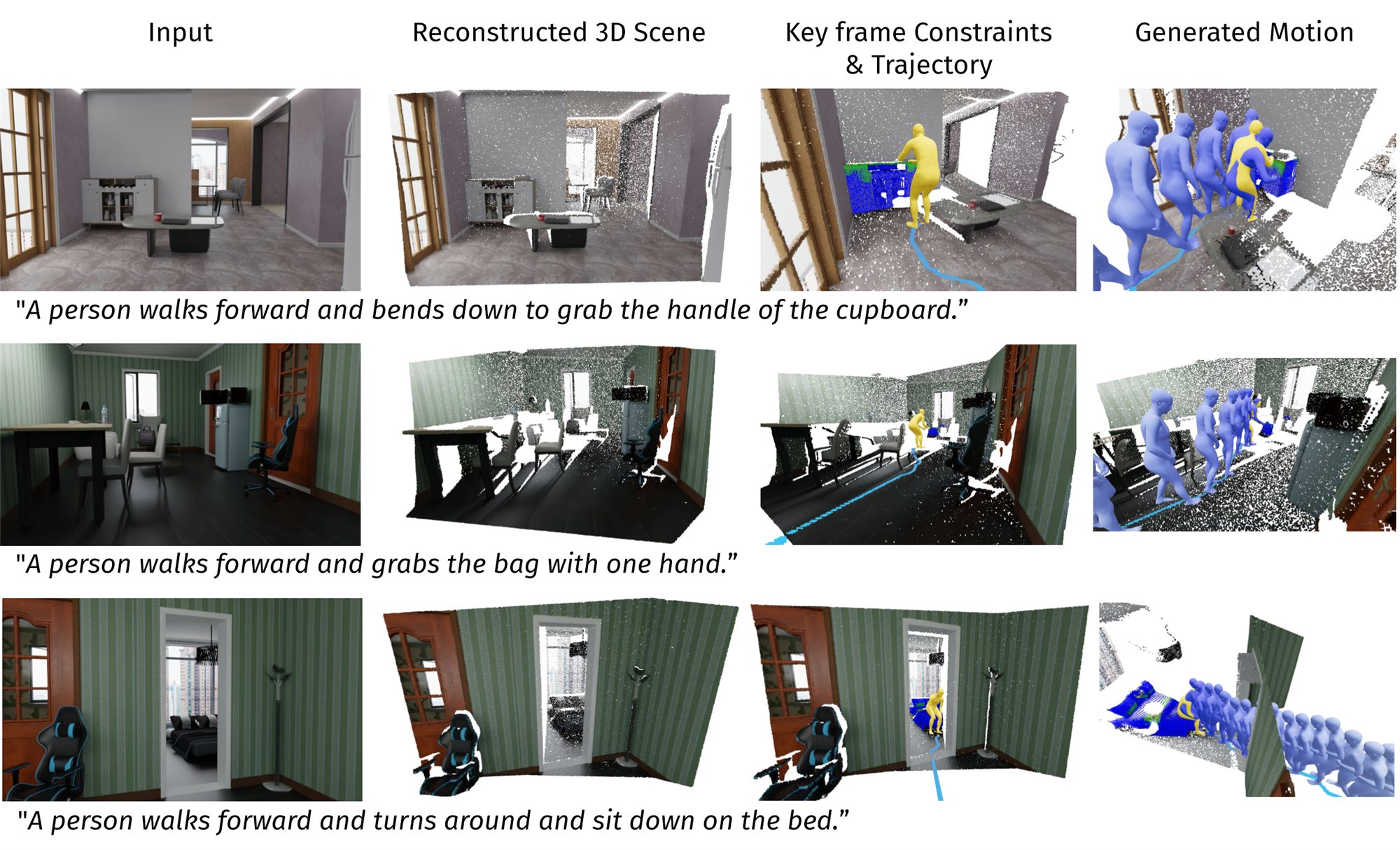
Given a single image of a room and a sentence such as “a person walks to the black armchair and
sits down,” producing a 3D motion sequence of a virtual person performing the described action is
out of reach for existing methods. Scene-conditioned methods need hours of paired (scene, motion,
language) capture. Zero-shot methods need a pre-scanned 3D scene. Image-based methods produce only static
poses. We propose a training-free pipeline that synthesizes scene-aware human-scene interaction (HSI)
motion from a single RGB image and a free-form text prompt, with no HSI-specific training and no
pre-scanned 3D scene. The key observation is that every needed capability already exists as a frozen
foundation model: the bottleneck is composition, not capability.
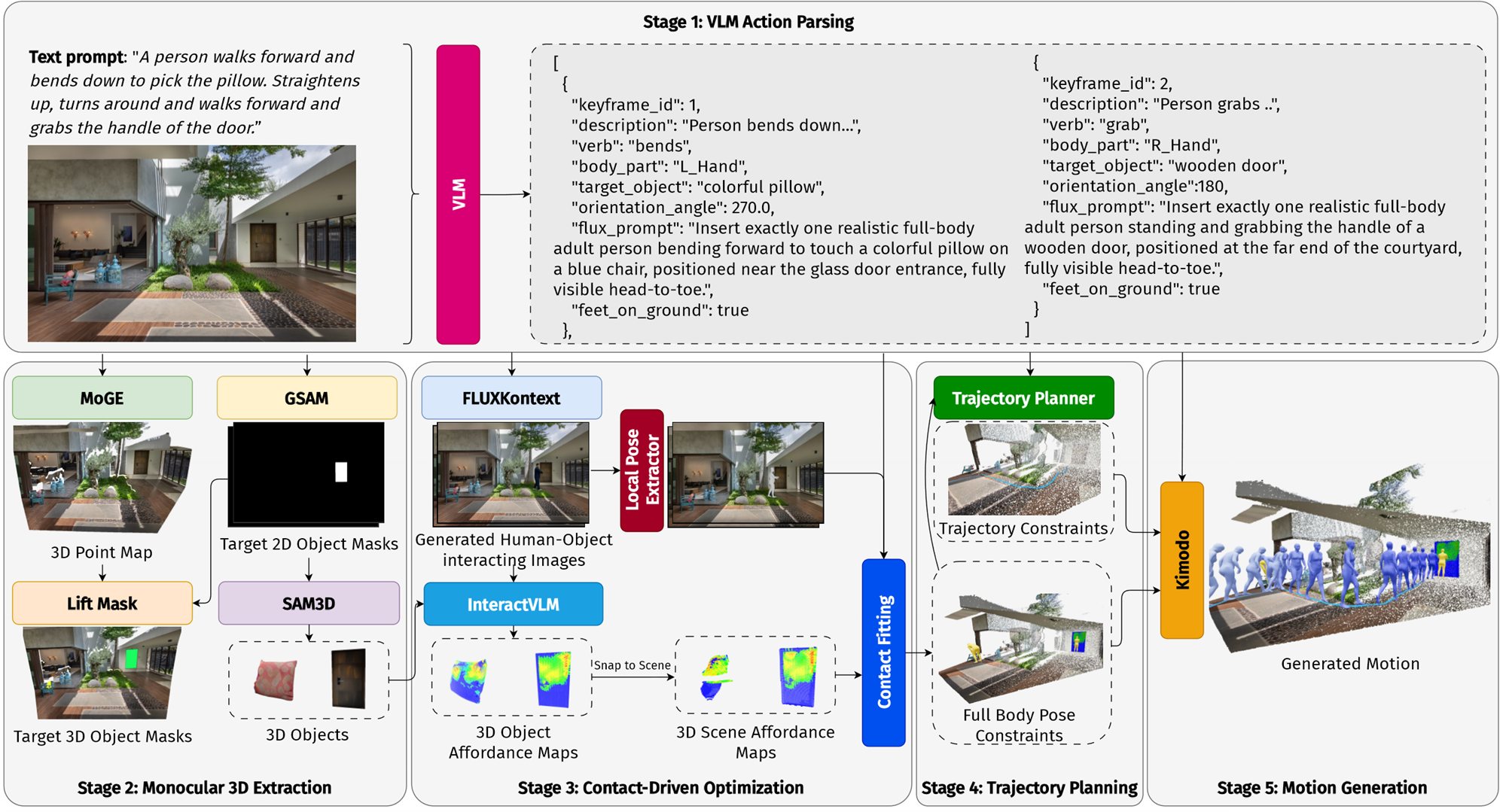
Our method, ENACT, uses a vision-language model (VLM) for high-level reasoning. The VLM parses the input
image and prompt into one structured keyframe per sentence, listing the action verb, the body part, the
target object, a six-bin contact yaw, an image-edit prompt, and a foot-grounding flag. The keyframe then
drives six frozen specialists: a monocular 3D model for the scene point cloud, an open-vocabulary
segmenter for object localization, a single-view mesh reconstructor for object geometry, an
instruction-following image editor for a synthetic interaction image, an image-conditioned human-mesh
recoverer for pose initialization, and a 2D-grounded 3D contact predictor for object affordance.
Per-keyframe contact poses are optimized under a whole-body diffusion prior, and a constraint-conditioned
motion diffuser connects successive keyframes into one continuous motion.
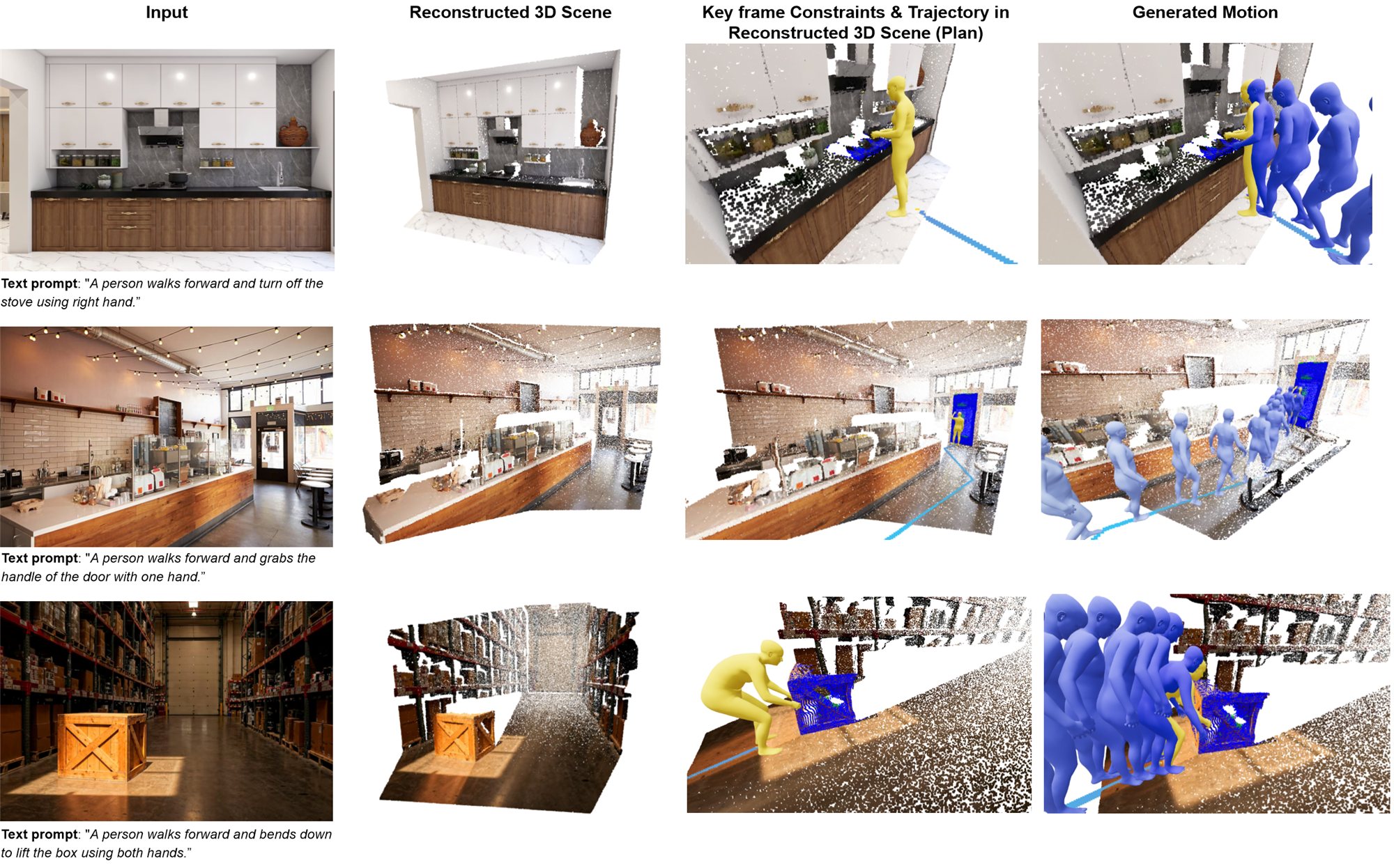
ENACT achieves the lowest mean and maximum scene penetration and the lowest foot sliding among all
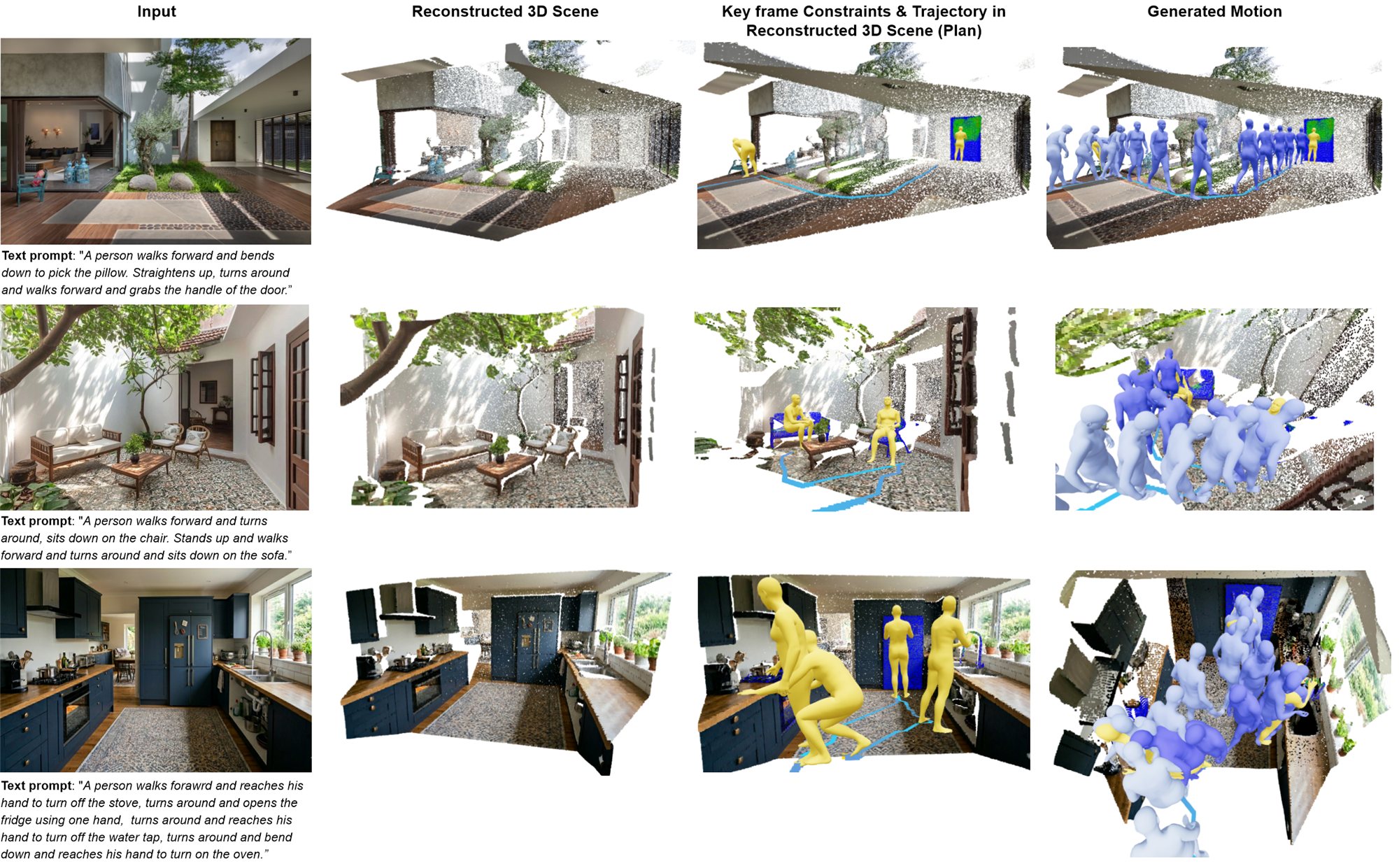
baselines on a standard HSI benchmark, despite consuming the smallest input. ENACT also generalizes to
synthetic datasets and to in-the-wild phone images, including chained multi-step interactions.