ENACT: Single-Image Human-Scene Interaction Motion from Language via Foundation-Model Orchestration

NeurIPS 2026

1Machine Learning Lab, IIIT Hyderabad, 2Max Planck Institute for Intelligent Systems, Germany
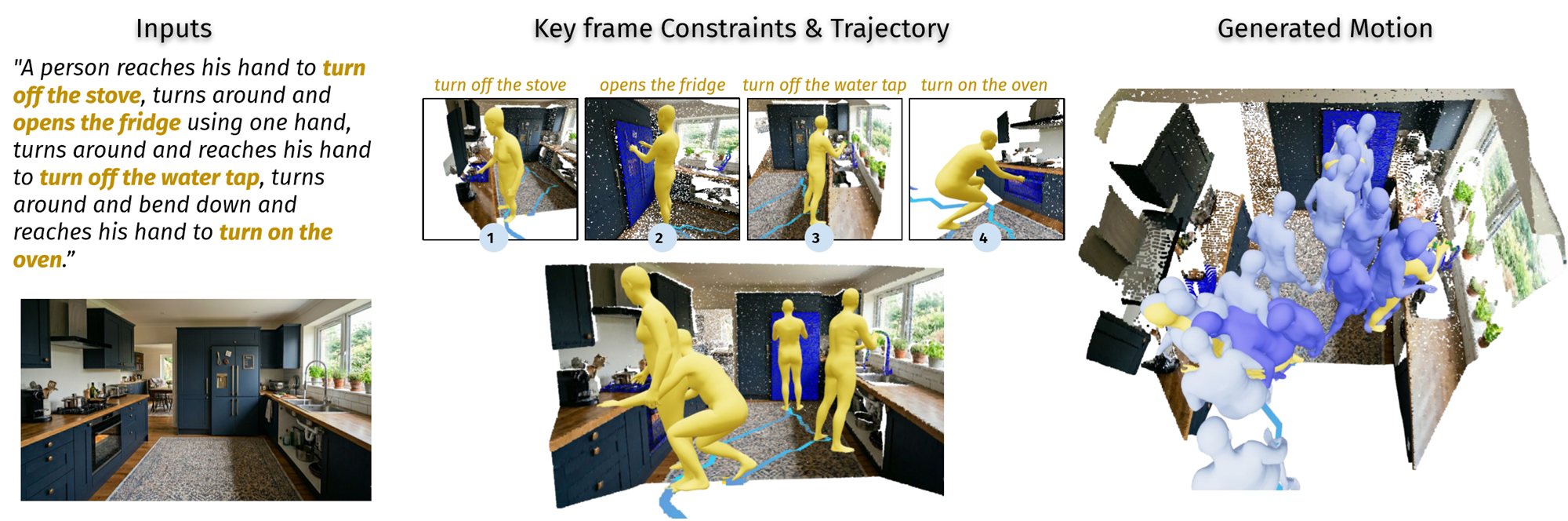
ENACT turns a kitchen photo and a four-step instruction into one continuous 3D motion.

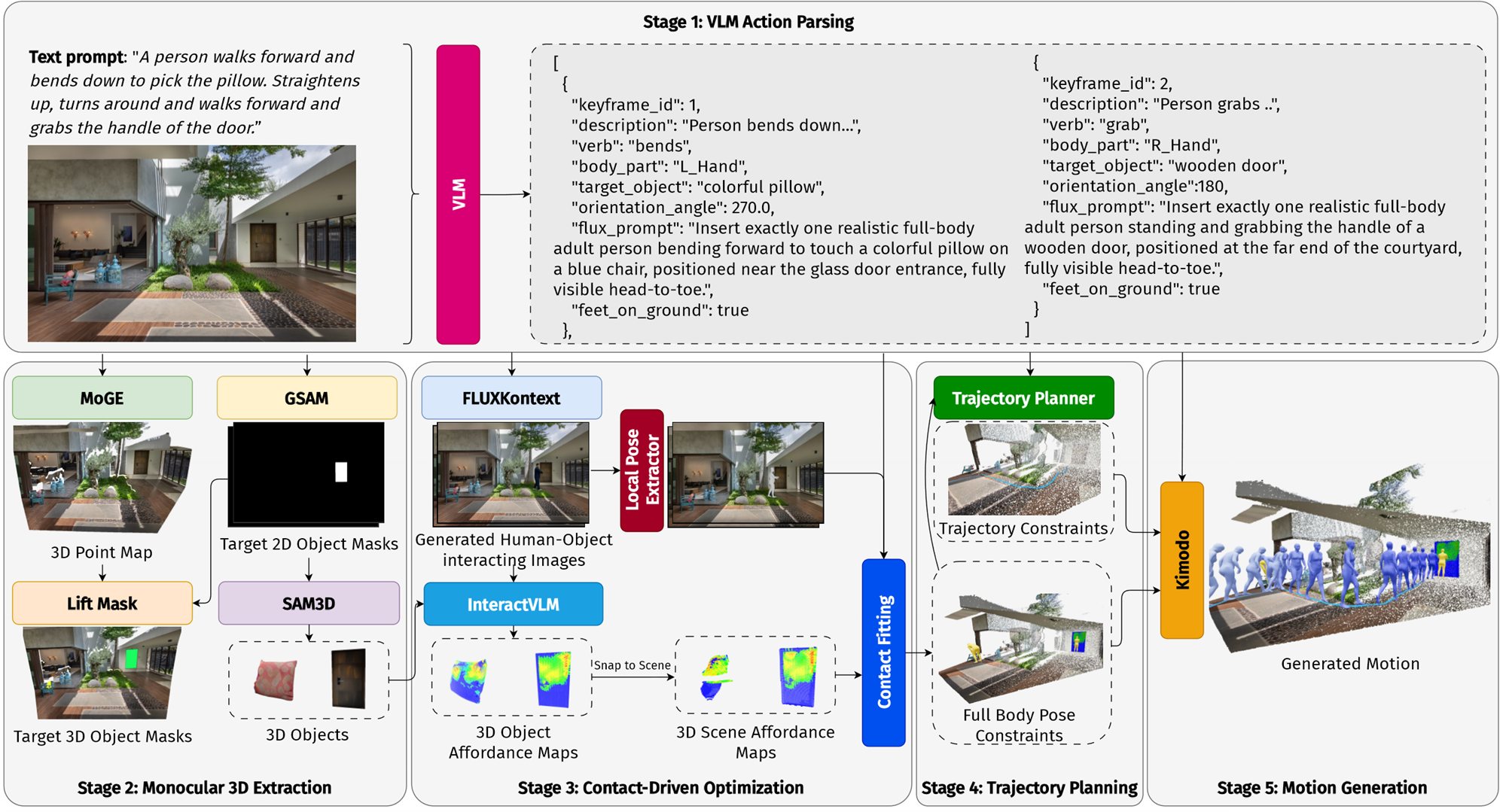
ENACT synthesizes scene-aware human-scene interaction motion from a single image and a free-form sentence. The instruction is parsed into a sparse set of contact keyframes, each keyframe is resolved to a contact-consistent pose on the reconstructed scene, and a constraint-aware diffusion model fills the motion between keyframes into one continuous sequence. No stage is trained on HSI data.

Abstract

Given a single image of a room and a sentence such as “a person walks to the black armchair and sits down,” producing a 3D motion sequence of a virtual person performing the described action is out of reach for existing methods. Scene-conditioned methods need hours of paired (scene, motion, language) capture. Zero-shot methods need a pre-scanned 3D scene. Image-based methods produce only static poses. We propose a training-free pipeline that synthesizes scene-aware human-scene interaction (HSI) motion from a single RGB image and a free-form text prompt, with no HSI-specific training and no pre-scanned 3D scene. The key observation is that every needed capability already exists as a frozen foundation model: the bottleneck is composition, not capability. Our method, ENACT, uses a vision-language model (VLM) for high-level reasoning. The VLM parses the input image and prompt into one structured keyframe per sentence, listing the action verb, the body part, the target object, a six-bin contact yaw, an image-edit prompt, and a foot-grounding flag. The keyframe then drives seven frozen specialists: a monocular 3D model for the scene point cloud, an open-vocabulary segmenter for object localization, a single-view mesh reconstructor for object geometry, an instruction-following image editor for a synthetic interaction image, an image-conditioned human-mesh recoverer for pose initialization, a 2D-grounded 3D contact predictor for object affordance, and a constraint-conditioned motion diffusion model for motion synthesis. Per-keyframe contact poses are optimized under a whole-body diffusion prior, and the motion diffusion model connects successive keyframes into one continuous motion. ENACT achieves the lowest mean and maximum scene penetration and the lowest foot sliding among all baselines on a standard HSI benchmark, despite consuming the smallest input. ENACT also generalizes to a synthetic dataset and to in-the-wild phone images, including chained multi-step interactions.
Interactive demos

Explore the results in 3D

Each demo plays the generated motion inside the scene reconstructed from a single photo. Drag to orbit, scroll to zoom, and scrub the timeline. Blue is the walk, yellow the interaction, and the translucent yellow bodies are the fitted contact poses.

Open full-screen

Method

ENACT pipeline: VLM action parsing, monocular 3D extraction, contact-driven optimization, trajectory planning, motion generation.

Stage 1 – VLM action parsing. A frozen VLM turns the image and instruction into one structured keyframe per sentence. Stage 2 – Monocular 3D extraction. MoGe recovers a metric scene point map, Grounded-SAM segments the target object and floor, and SAM 3D completes the object mesh. Stage 3 – Contact-driven optimization. FLUX-Kontext inserts a person performing the interaction, GVHMR initializes the pose, InteractVLM predicts object affordances that are snapped onto the measured scene, and the pose is fitted to the contacts under the DPoser-X whole-body prior. Stage 4 – Trajectory planning. A* plans an obstacle-aware walk on the walkable floor. Stage 5 – Motion generation. Kimodo infills walking, interaction, and transition phases into one continuous motion.

Pipeline

Under the hood, one stage at a time

The same kitchen, stage by stage. Step through the five stages to see the parsed keyframes, the reconstructed scene and object meshes, the predicted affordance and fitted contact poses, the planned route, and the generated motion — each with its 2D evidence and what it adds to the 3D scene.

Open full-screen

Video

Results

In-the-wild images

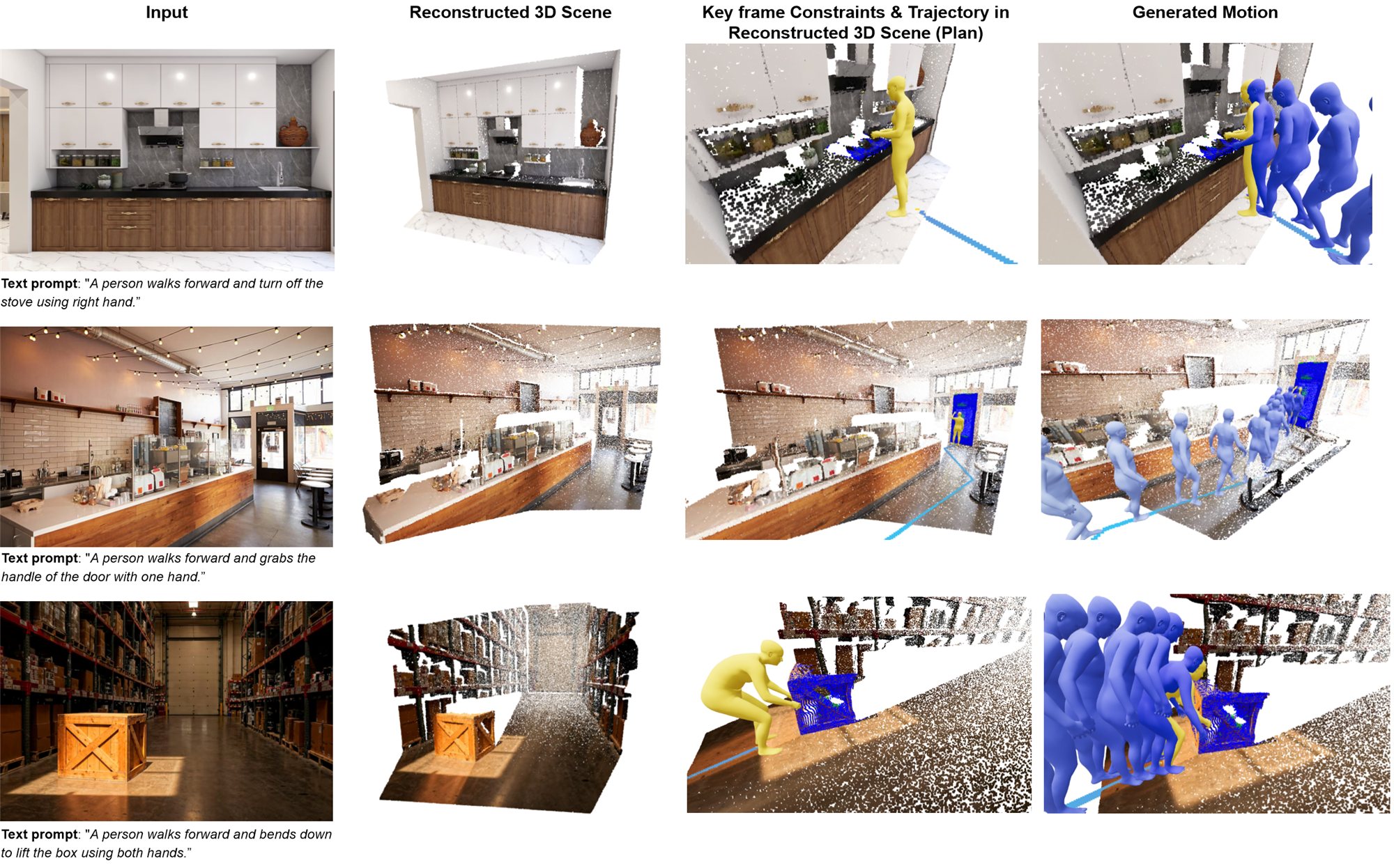
ENACT on in-the-wild photos: kitchen, cafe, and warehouse.

ENACT generalizes to uncurated photos, producing contact-consistent motions despite noisy monocular reconstruction.


Multi-step interactions

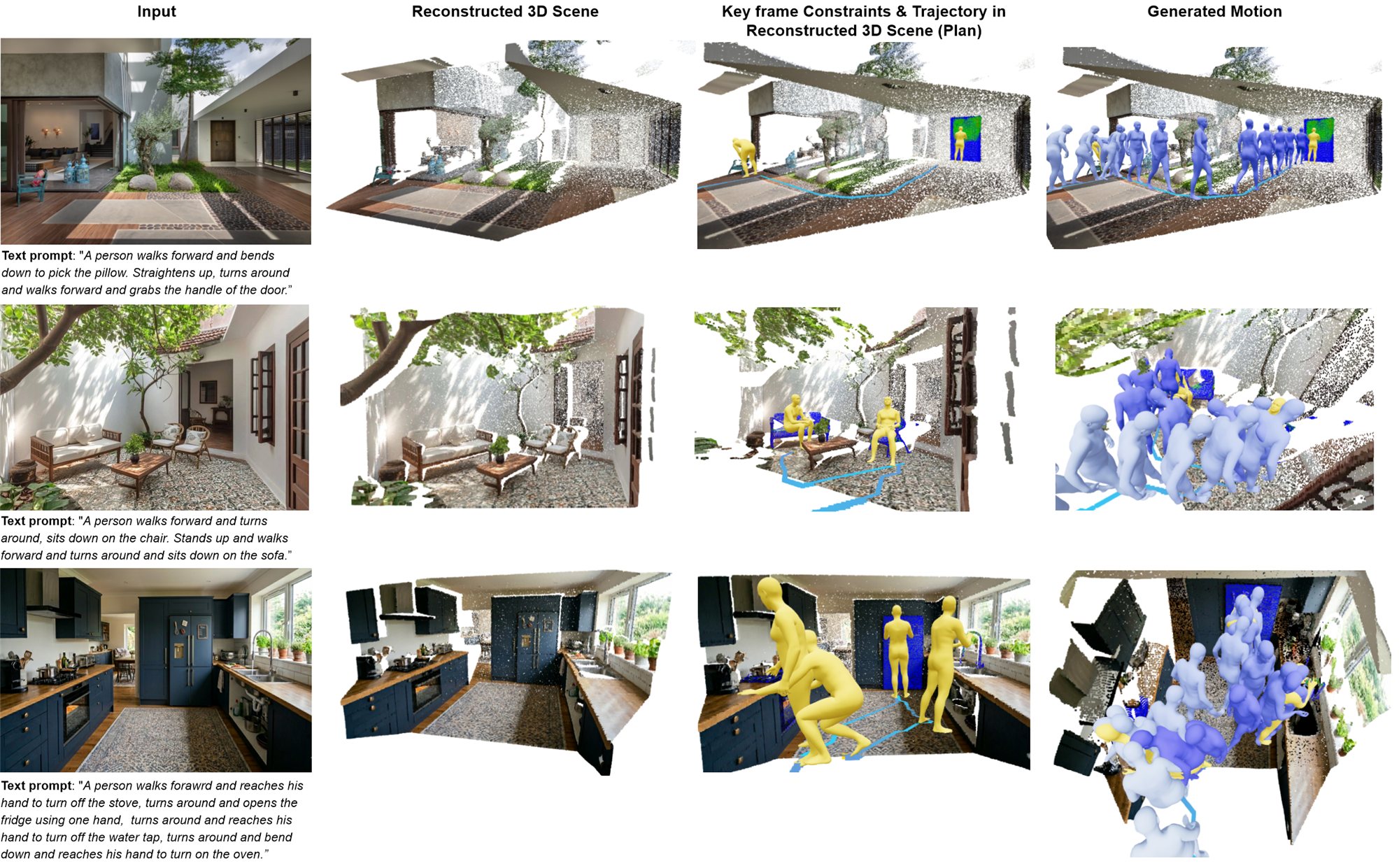
ENACT executing multi-sentence prompts as one continuous motion.

A multi-sentence prompt is executed as one continuous motion: each sentence becomes a keyframe, the planner connects successive keyframes on the walkable region, and a transition phase bridges interaction segments.


AnyInteraction benchmark

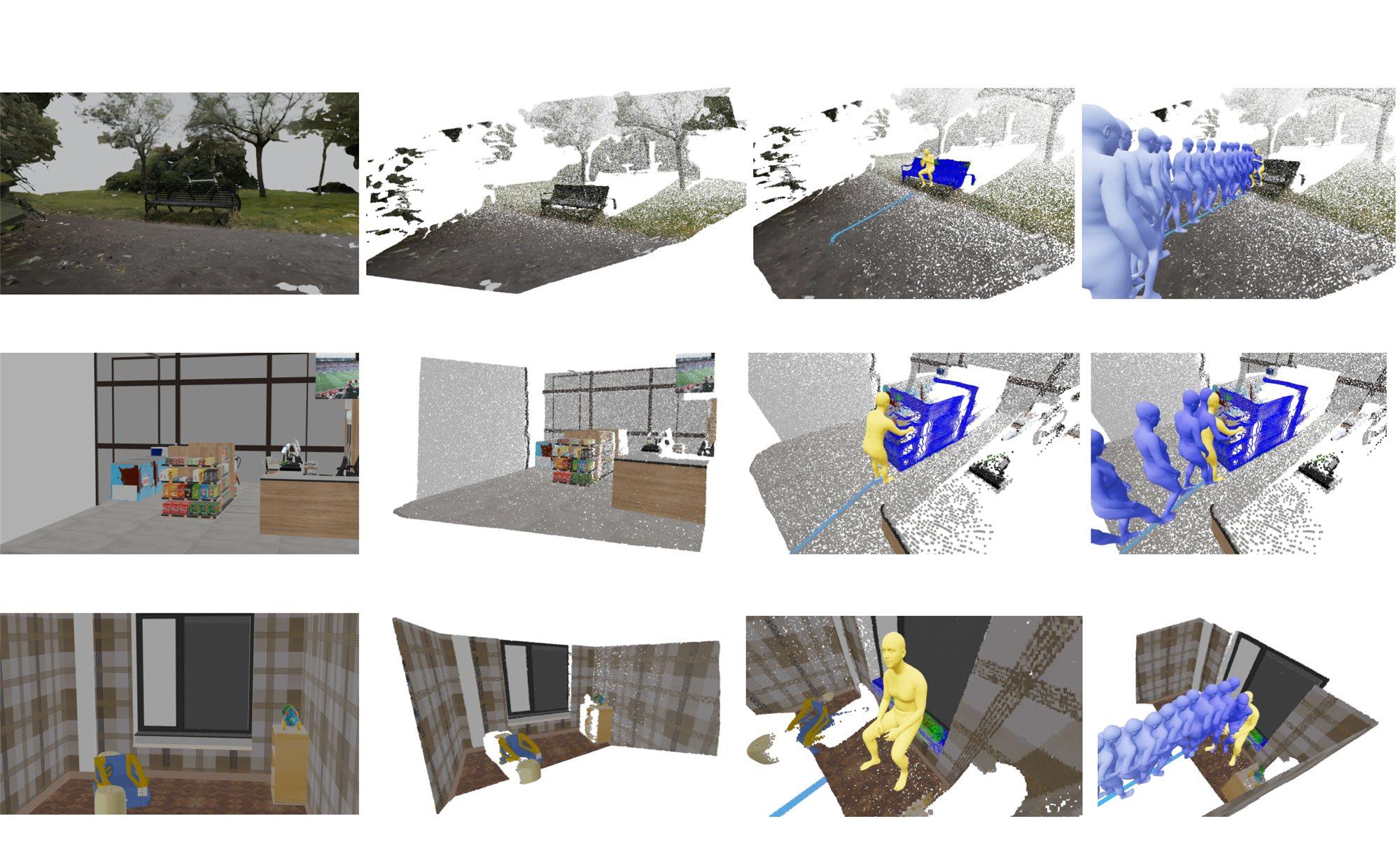
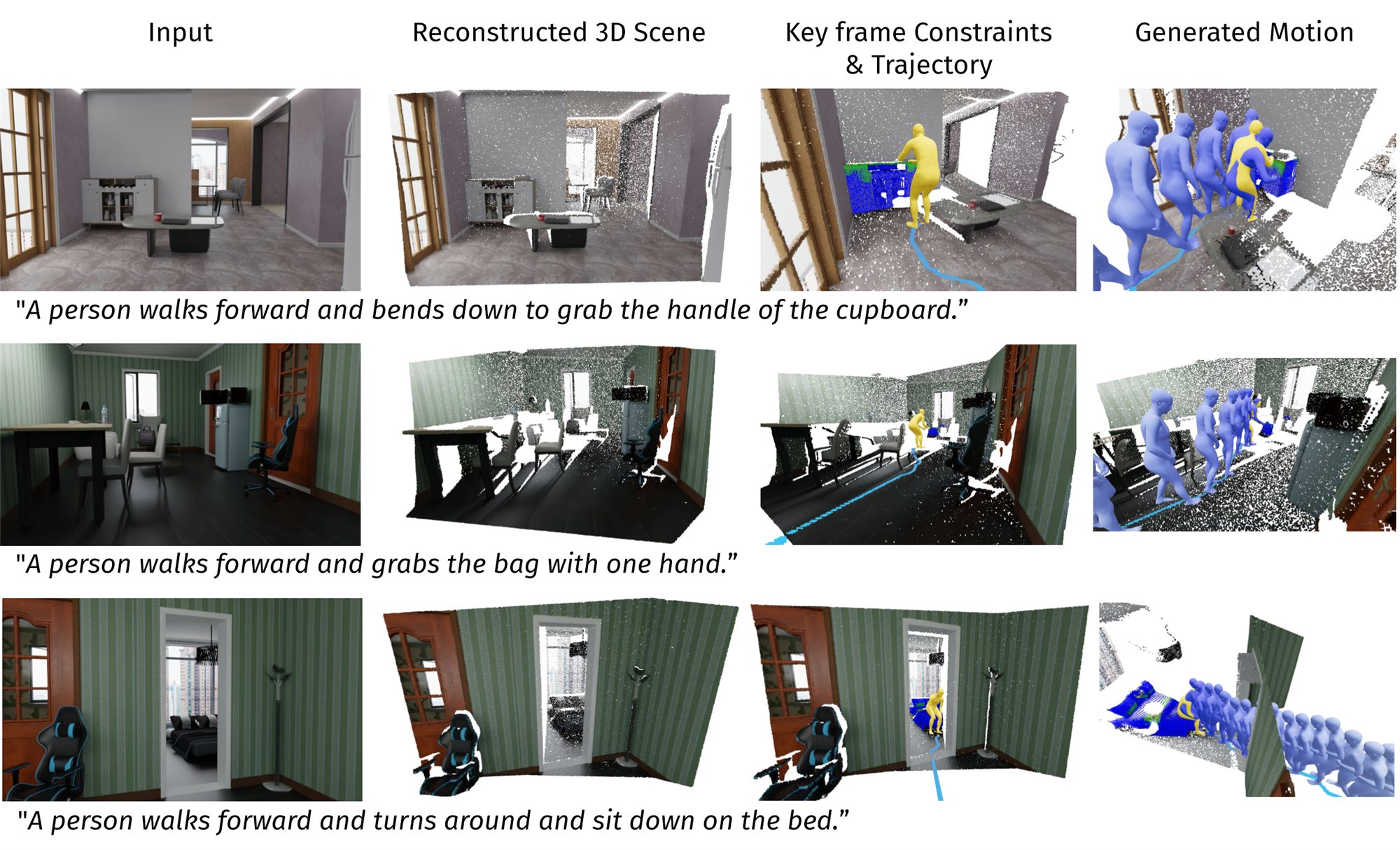
ENACT on AnyInteraction scenes: input, reconstruction, plan, and generated motion.

Columns: input image, reconstructed scene, keyframe constraints and planned trajectory, and generated motion.


TRUMANS scenes

ENACT on synthetic TRUMANS scenes.

Generalization to synthetic TRUMANS scenes without per-scene tuning.